


 formation
The process
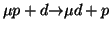 can be experimentally monitored
by
can be experimentally monitored
by
atom
 fusion channel going to

|
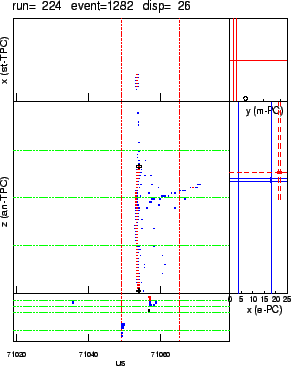
Fig. 19 shows
a typical event from our 1999 run where only natural hydrogen
(c = 140 ppm) was used. Under this condition,
  transfer to
deuterium occurs at a rate of
transfer to
deuterium occurs at a rate of  5% and is found quite easily,
while in
5% and is found quite easily,
while in  runs it is absent. The number of muon diffusion
events at well defined conditions is - after a proper calibration
is made - a direct measurement of c. Details of the
diffusion distribution and the procedures which we will use to calibrate
it are shown below (chapter 5.4.3).
runs it is absent. The number of muon diffusion
events at well defined conditions is - after a proper calibration
is made - a direct measurement of c. Details of the
diffusion distribution and the procedures which we will use to calibrate
it are shown below (chapter 5.4.3).
Fig. 20 shows the result of a diffusion search in data
from our test runs. These are plots of diffusion distance versus
decay time. The outlying points in the left image are from the
diffused atoms in a run. For reference only
a single event at t=0 leaks through in a run shown
on the right. The amount of these outlying events will allow
us to accurately calibrate the amount of deuterium in the
runs and to check our models of the distribution.
Note that in these analyses an approximately 95% efficient
TPC electron tracking algorithm was used to eliminate events
where an electron track was found near the  -stop even though
the wire chamber tracking pointed several cm away. For this
reason it is important that we have reasonable electron
efficiency in the TPC but do not need 100%.
-stop even though
the wire chamber tracking pointed several cm away. For this
reason it is important that we have reasonable electron
efficiency in the TPC but do not need 100%.
Several clean candidates of process 2) were observed in the TPC during special runs using 3 hardware thresholds. More statistics of these events will be collected during future test runs, which is necessary to judge whether sufficient background suppression is achievable at the level of 1 ppm deuterium anticipated for the final run.
 in this example) which is typical for such events!