We report here a method developed for on-line control of impurity levels in
hydrogen. Using the TPC as active target we can detect the charged products of
muon induced reactions with impurities. Most critical are the following admixtures:
O , N, HO and D. The TPC can detect
recoil nuclei (200-350keV) from
, N, HO and D. The TPC can detect
recoil nuclei (200-350keV) from  -capture on impurities with Z
 2
and from the
2
and from the  fusion channel
 .
The information is collected both with our TDC system and from 12 TPC anodes
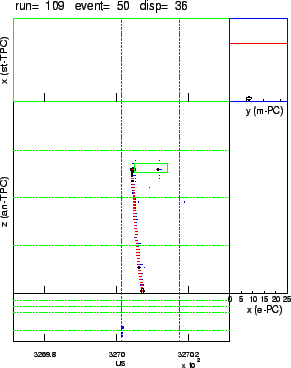
instrumented with FADC's. The selection of these events by the TPC is quite powerful,
see Fig. 17. Here we report about the analysis of the FADC data, which
provides detailed amplitude information, albeit with a limited data acquisition
rate and volume coverage compared to the TDC's.
.
The information is collected both with our TDC system and from 12 TPC anodes
instrumented with FADC's. The selection of these events by the TPC is quite powerful,
see Fig. 17. Here we report about the analysis of the FADC data, which
provides detailed amplitude information, albeit with a limited data acquisition
rate and volume coverage compared to the TDC's.
|
The -capture reactions are identified as events with two big signals
on the muon stop anode separated in time, where the first one is the signal
from stopped muon with energy up to 220 keV, the second one is from the nuclear
recoil. For the selection of such event types special amplifiers and discriminators
with high threshold about 70 keV and a trigger control unit was developed.
Typical transfer and capture rates as well as the calculated capture yields
at 1 ppm contamination are given below. In the sequence


 Z
capture occurs some mm away from the stop anode, because of
Z
capture occurs some mm away from the stop anode, because of  diffusion.
| element | N | O |
| capture rate | 66 4 4 |
102.51.0 |
transfer rate from  (10 (10 ) ) |
3.40.7 |
8.5 |
capture yield
Z  @c @c =1 ppm =1 ppm |
80 ppm | 300 ppm |
| transfer rate from (10) |
14.60.6 |
6.2 |
| capture yield
Z @c=1 ppm |
10 ppm | 8 ppm |
The main background source are  -electrons from -decay
electrons and double muons, i.e. two muons which can however be easily
discriminated [3].
-electrons from -decay
electrons and double muons, i.e. two muons which can however be easily
discriminated [3].
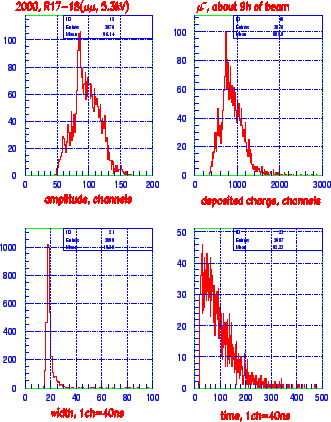
For selecting  -capture events on impurities the following criteria
were imposed on FADC events: a) Signal with amplitude larger than
50 channels on the muon stop anode, appearing during 16
-capture events on impurities the following criteria
were imposed on FADC events: a) Signal with amplitude larger than
50 channels on the muon stop anode, appearing during 16  after
the muon signal, b) the width of this signal must remain below 2 ,
c) No other tracks in the chamber or signals on neighboring
anodes at the same time.
after
the muon signal, b) the width of this signal must remain below 2 ,
c) No other tracks in the chamber or signals on neighboring
anodes at the same time.
The signal spectra are shown in Fig. 18. We found 3876 -capture
events with  beam and only one event under the same requirements
with
beam and only one event under the same requirements
with  beam. The number of monitored muon stops in the sensitive TPC
volume was about 10
beam. The number of monitored muon stops in the sensitive TPC
volume was about 10 . The overall level of impurities
(N
. The overall level of impurities
(N , O and HO) was estimated to be about 30 ppm by using chemical
analysis. Based on these data we can conclude that our method has reached
a sensitivity to determine impurities with Z
, O and HO) was estimated to be about 30 ppm by using chemical
analysis. Based on these data we can conclude that our method has reached
a sensitivity to determine impurities with Z 1 of about 0.01 ppm.
 data.
data.